Nail sickness is the defining roofing issue for Chester's post-war estates — Blacon, Lache, parts of Upton and Ellesmere Port. This guide covers identification, the repair vs replace decision and realistic costs.
Tell us the job in 30 seconds. No pushy sales, no call-out fee.
📞 Call Now: 0124 463 7110Nail sickness is the corrosion and failure of the iron nails fixing slates or tiles to a Chester roof. It affects most Chester properties built before 1970, since iron nails have an 80 to 100 year design life. The fix is re-nailing or re-roofing with stainless steel fixings.
Nail sickness is the progressive failure of the iron nails fixing concrete interlocking roof tiles on post-war housing. When iron nails corrode, they expand slightly and then crumble — losing their grip on the tile batten and leaving tiles held only by gravity and the friction of adjacent tiles. In moderate winds, these tiles slip or displace. In severe storms, whole sections of roof can fail.
The condition is endemic to post-war housing built between approximately 1947 and 1980, which is the dominant building era for large sections of Chester's residential stock. Blacon, Lache, parts of Upton and the large post-war estates in Ellesmere Port are the primary affected areas in the Chester region.
Chester context: Iron nails have an expected lifespan of 50 to 75 years in the UK climate. A Blacon property built in 1958 hit that threshold between 2008 and 2033. Most of Blacon is now at or past the point of widespread nail failure.
You don't need to go on the roof to assess nail sickness. From ground level with binoculars: look for tiles that have slipped down the roof slope from their original position; tiles that have rotated slightly so their profile no longer aligns with adjacent tiles; small gaps appearing where tile courses should be continuous; and dark staining below displaced tiles where water is penetrating.
Inside the property: look for damp patches on ceilings or in the loft on days when it has not rained heavily — this is wind-driven rain entering through slightly displaced tiles rather than direct ingress from a hole.
| Nail-Sick Tile % | Recommendation | Reason |
|---|---|---|
| Under 15% | Individual tile replacement | Economical. Replace failed tiles on a call-out basis. |
| 15% to 40% | Partial slope replacement | Full batten and membrane on affected slopes. Preserves the sound areas. |
| 40% to 60% | Full re-roof strongly recommended | Patching the remainder will cost more than full replacement within 5–10 years. |
| Over 60% | Full re-roof essential | The roof is in progressive failure. Every storm risks major displacement. |
These thresholds come from our experience carrying out condition surveys across Chester's post-war estates, not from a manufacturer's specification sheet. The key variable is the remaining tile stock: if 42% are nail-sick, the remaining 58% are on the same iron nails in the same conditions — they will fail progressively, and you will be paying for multiple repair visits regardless.
A free condition survey for nail sickness involves: safe access by ladder to a sufficient sample area on each roof slope; counting and percentage calculation of displaced, loose and firm tiles; underlay and batten condition assessment; and a written report with a genuine recommendation that may or may not involve full replacement.
We give you the actual percentage. We do not round up to justify a full re-roof if the real figure is 12%. And we do not recommend continued patching if the real figure is 45%.
Per call-out. Appropriate under 15% failure.
Full batten, membrane and tile on affected slope.
Complete replacement. 10-year guarantee. See our re-roof cost guide.
Written report with actual percentage and recommendation.
BS 5534, the British Standard code of practice for slating and tiling, specifies austenitic stainless steel or silicon bronze nails for slate fixing — iron nails used on pre-1970 Chester roofs fall well short of this modern standard.
Source: British Standard BS 5534:2014+A2:2018
Everything on this page represents our practical experience carrying out roofing work across Chester, Hoole, Blacon, Handbridge, Upton and surrounding areas. If you have a specific question about your own roof, call us — free no-obligation advice, no call-out fee.
📞 Call 0124 463 7110“Survey showed 44% nail sick on our Blacon semi — Chester Roofing Experts recommended full re-roof and were right. Proper condition survey, not just a sales visit.”
“12% nail sick — they recommended individual tile repair rather than a full replacement. Honest advice, saved us a significant amount.”
“Ellesmere Port survey — 52% failure rate. Full re-roof was the right call. Done in five days, excellent finish.”
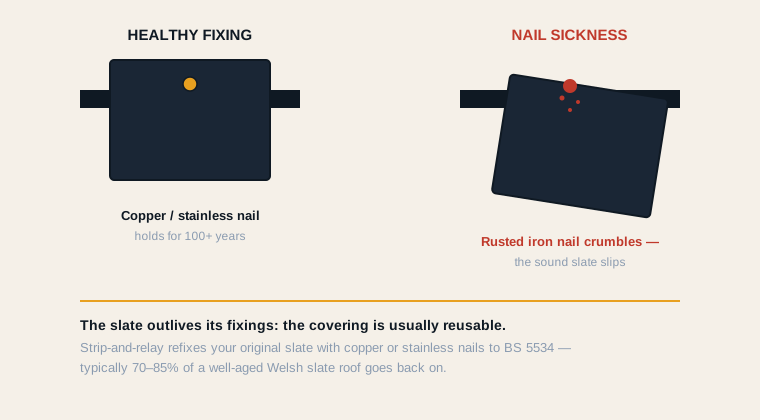
When nail sickness has set in across a Chester slate roof, the solution is not endless individual repairs — refixing slipped slates one by one only chases a problem that keeps reappearing as more nails fail. The proper fix is a strip-and-relay: the slates are carefully removed, the failed nails and old underlay discarded, and the sound slates — typically 70–85% of the original Welsh slate on a Chester Victorian roof — relaid on new breathable underlay and treated battens, refixed with modern stainless steel or copper nails that will not corrode.
The beauty of a strip-and-relay is that it keeps the roof’s original character and much of its original material, at well below the cost of an all-new slate roof, while giving it another century of life free of the nail-sickness problem. It is the ideal answer for the Victorian and Edwardian slate terraces of Hoole, Boughton and the Garden Quarter, where the slate is beautiful and worth preserving but the Victorian iron nails have simply reached the end of their life. A survey confirms how much of the existing slate can be reclaimed, which determines the cost.
Over 40% nail-sick tiles: full re-roof is more economical long-term than continued patching. 15 to 40%: partial slope replacement. Under 15%: individual tile repair on a call-out basis. We give you the actual percentage at the free condition survey.
Depends on percentage: individual tile repair £200 to £600 per call-out; partial slope £900 to £2,800; full re-roof £4,500 to £9,000 for a typical 3-bed Chester post-war semi.
Blacon, Lache, parts of Upton and the large post-war estates in Ellesmere Port. All built primarily between 1947 and 1975 with iron nails now at or past 50 to 75 year expected lifespan.
Yes, if the failure rate is under 15%. Above 40%, continued patching costs significantly more than full replacement within 5 to 10 years. We give you the honest number at the free survey.
Check NFRC registration — the National Federation of Roofing Contractors maintains a verified member database. Ask for a written itemised quote rather than a verbal estimate. Check Google reviews with specific job references. Be wary of door-knock contractors offering unsolicited discounts — legitimate local roofers don't cold-call.
Yes. NFRC registration means we meet recognised industry standards for quality, safety and workmanship, carry adequate public liability insurance, and operate to a code of practice. All work is also covered by our written 10-year workmanship guarantee.
Yes — all roofing work carried out by Chester Roofing Experts is covered by a written 10-year workmanship guarantee. Materials are covered by manufacturer warranties. We are fully insured with £5m public liability cover on every job.
No call-out fees. No obligation. An honest quote from a local Chester roofer.
0124 463 7110 ✉ Email Us Instead