Home › Services › Should You Repair or Replace Your Roof?
Honest Decision Guide
Should You Repair or Replace Your Roof?
An honest framework for the repair-or-replace decision on a Chester roof — by housing era, using the 30% rule and cost-per-remaining-year logic, with straight answers both ways.
Tell us the job in 30 seconds. No pushy sales, no call-out fee.
Repair if your Chester roof is structurally sound and the problem is localised. Replace once failure is widespread, the fixings have gone (nail sickness), or the underlay has perished. The 30% rule is the guide: past roughly a third of the covering failed, a full re-roof is better value than tile-by-tile repairs.
The decision
How to Decide: Repair or Replace in Chester
It is one of the most common — and most expensive — decisions a Chester homeowner faces. Repair too long and you pour money into a dying roof; replace too early and you spend thousands you did not need to. The honest answer depends on three things: how much has failed, whether the fixings have gone, and whether the underlay is sound.
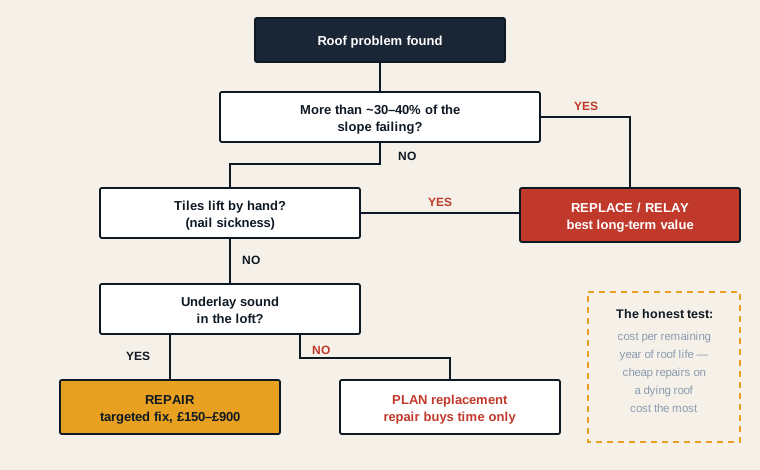
The decision comes down to how much has failed, whether the fixings have gone, and whether the underlay is sound.
Work down the tree. If more than roughly a third of the slope has failed, replacement is the better long-term value. If not, the next question is whether the tiles or slates lift by hand — the sign of nail sickness — because widespread fixing failure means a re-roof regardless of how good the slate looks. If the fixings are fine, the last question is the underlay: sound underlay means a targeted repair will hold; perished underlay means you are planning a re-roof soon whatever you do now.
Chester stock
Repair or Replace by Chester Housing Era
The right answer shifts with the type of property, and Chester’s housing eras each behave differently. On the Victorian and Edwardian slate terraces of Hoole, Boughton and Newton, the slate itself often has decades left — it is the iron nails that fail. Here a strip-and-relay, reusing 70–85% of the original Welsh slate with new fixings, is frequently the sweet spot between repair and full replacement.
On the 1930s semis of Upton and Newton, plain tile and early concrete roofs tend to fail at the fixings and mortar first. Localised repair works well until nail sickness spreads, at which point a re-roof in matching tile is the sensible move. On the post-war concrete-tile estates of Blacon and Lache, the tiles are durable but the fixings and underlay are usually the weak point — and these estates are where full re-roofs most often become the economic choice over repeated patching.
Chester’s wet, exposed climate accelerates all of this. A roof that might limp on for years in a drier region gives way faster here, so condition at survey — not the age on paper — is what we go on.
The economics
The Cost-Per-Remaining-Year Logic
The clearest way to think about repair-or-replace is cost per remaining year of roof life. A £300 repair that buys one more year before the next failure costs you £300 a year. A £8,000 re-roof that lasts 60 years costs around £130 a year. On a dying roof, cheap repairs are the most expensive option — they feel cheaper each time but never stop the underlying failure.
That is why the 30% rule works: once a third of the covering has gone, you are almost certainly into repairs that only buy months, and the cost-per-year of continued patching climbs above the cost-per-year of replacement. Below that threshold, with sound fixings and underlay, repair wins on the same maths.
Localised repair, sound roof: repair — lowest cost per year
Widespread nail sickness: replace or strip-and-relay — resets the clock
Perished underlay: plan replacement — repairs are borrowed time
One failed detail on a good roof: repair — replacement would be an oversell
Honest both ways
When Replacement Is an Oversell
Plenty of Chester homeowners are told they need a new roof when a repair would do. If the covering is sound and only a localised area or single detail has failed, a re-roof is unnecessary — and we will say so. The 10-year workmanship guarantee we give on a repair is the same promise we stand behind on a re-roof; we have no reason to sell you more roof than you need.
Equally, we will not patch a dying roof just to win a cheaper job today. If the honest answer is replacement, we explain why, show you the evidence from the survey, and let the cost-per-year logic speak for itself. Straight answers both ways is the whole point.
Getting it checked
How We Confirm the Right Call on Your Chester Roof
The decision tree gives you the logic, but the honest answer for your specific roof comes from a proper survey — free, with no obligation. On a Chester roof we look for the tell-tale signs at close quarters: are slates lifting by hand across the slope, or is it just one or two? Are the nail heads rusted through in the loft? Is the underlay supple or has it gone brittle and torn? Is the timber sound, or is there movement in the ridge line?
We use a drone on tall or awkward roofs to inspect without disturbing anything, and we go into the loft wherever access allows, because the underside tells you as much as the top. Only then do we give you a straight recommendation — repair, strip-and-relay, or full replacement — with the reasoning shown, not just a price.
The strip-and-relay middle option
On Chester's many Welsh slate roofs there's a valuable middle path people often don't know about. If the slate is sound but the nails have failed — classic nail sickness — we can strip the roof, salvage 70–85% of the original slate, and relay it with new breathable underlay, treated battens and stainless or copper nails. You keep the authentic period slate and the conservation-friendly look, at well below the cost of all-new material. For a Hoole or Garden Quarter terrace it's frequently the best-value answer of all.
Whatever the outcome, the survey is free and the recommendation is honest. If a repair will genuinely see you right for years, that's what we'll tell you — and if a re-roof is being oversold to you elsewhere, we'll show you why it isn't needed yet.
FAQ
Frequently Asked Questions
Repair if the structure is sound and the problem is localised — a few slipped tiles, one failed flashing. Replace once failure is widespread across the slope, the fixings have gone (nail sickness), or the underlay has perished. The 30% rule is a useful guide: past roughly a third failed, replacement is better value.
A rule of thumb: if more than about 30% of the roof covering has failed, repairing tile-by-tile costs more over time than a full re-roof. Below that, targeted repair is usually the economic choice. It is a guide, not a law — a survey confirms the right call.
A natural Welsh slate roof lasts 80–100 years; concrete tile 40–60 years; the fixings and underlay often fail before the covering. Chester’s wet, exposed climate is hard on roofs, so age alone is less telling than the condition found at survey.
Yes. Once a Chester roof shows widespread nail sickness — slates slipping across the whole slope — each repair only buys months. A full re-roof with stainless fixings resets the clock for decades and costs less than years of recurring repairs.
Often yes. On a well-aged Welsh slate roof, typically 70–85% of the slate can be salvaged and relaid with new fixings and underlay — a strip-and-relay. It keeps the period look and cuts material cost. We assess this at survey.
If the covering is sound and only a localised area or a single detail has failed, replacement is unnecessary — a repair is the honest answer. A reputable Chester roofer will tell you when a re-roof is not yet needed. We will.
The tell-tale sign is slates slipping in multiple places across the slope, not just one spot, often after wind. In the loft the nails may be visibly rusted. It is very common on Chester’s pre-1970 slate terraces and is the classic trigger for a re-roof.