⚡ Emergency roof repairs 24/7 — 0124 463 7110
Chester Roofing Guide

Roof Ventilation in Chester: Loft Condensation & Breathable Membrane

Roof ventilation is one of the least understood aspects of Chester roofing — and poor ventilation is the cause of a significant proportion of the loft condensation, mould and timber rot we find on Chester properties.

Why Roof Ventilation Matters in Chester
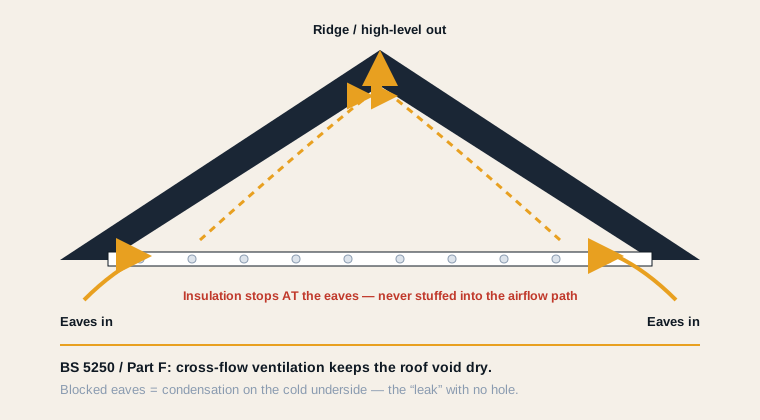
Roof void ventilation path: air in at the eaves, out at the ridge; blocked eaves cause condensation
Roof ventilation: air in at the eaves and out at the ridge keeps the void dry and prevents condensation.

Warm, moist air from living spaces rises through the ceiling and into the loft space in all Chester properties. If the loft is not adequately ventilated, this moisture cannot escape and condenses on cold surfaces — sarking felt, rafters and the underside of tiles. Over time, repeated condensation causes timber rot in the roof structure, mould growth on timber surfaces, and degradation of insulation. Chester's northwest climate — with more annual rainfall and less solar drying than southern England — makes adequate roof ventilation more important here than in drier regions.

Breathable Membrane on Re-Roofed Chester Properties

Older Chester properties built before the 1960s were roofed without any underlay, or with impermeable black bitumen felt. Bitumen felt prevents moisture that enters through the tile covering from draining to the eaves guttering, and eventually degrades and splits. When a Chester roof is re-roofed, we install breathable roofing membrane as standard. Breathable membrane allows water vapour from the loft to pass through and escape at the eaves while preventing liquid water ingress. It is significantly more durable than felt and improves the thermal performance of the roof.

Signs of Condensation Problems in a Chester Loft

Dark staining on the underside of rafters and sarking felt — particularly concentrated at the eaves — is the primary indicator of a condensation problem. Soft or discoloured insulation holds moisture and gradually loses its thermal performance. Mould growth on timber surfaces requires immediate attention. Metal fixings and tile nails showing rust staining indicate repeated wet-dry cycling. A loft inspection in spring, after the Chester winter, is the best time to identify these problems.

Ventilation Solutions for Chester Properties

Adequate roof ventilation on a typical Chester terrace requires an equivalent free area of 1/300 of the ceiling area at the eaves — most commonly achieved with ventilated soffit panels on all fascia sections. When we replace fascia and soffit on Chester properties we install ventilated soffit panels as standard. For properties where the existing eaves are blocked — common on Chester Victorian terraces with narrow eaves detail — ridge-level ventilation tiles provide the required airflow path without altering the roof appearance from the street.

Need a Chester Roofer?

Free survey, honest quote, no call-out fee.

0124 463 7110

Free No-Obligation Quote

0124 463 7110

No call-out fee · 24/7 emergency · 10-year guarantee

Why it matters

Why Roof Ventilation Matters in Chester’s Climate

Roof ventilation is one of the most overlooked yet important aspects of a Chester roof, and the city’s damp climate makes it more critical here than in drier parts of the country. A roof space needs a flow of air to carry away the moisture that inevitably rises from the living space below. Without it, that moist air condenses on the cold underside of the roof — and the result looks exactly like a leak: damp timbers, wet insulation, black mould, and staining, all with no hole in the roof to explain it.

Chester’s low-lying, humid setting means there is more moisture in the air to begin with, so a poorly-ventilated Chester loft reaches the point of condensation faster than one on higher, drier ground. It is a genuinely common problem across the city, and one that is frequently misdiagnosed — homeowners chase a non-existent leak while the real cause is trapped, moist air with nowhere to go.

How it works

How Roof Ventilation Works

Effective roof ventilation works by creating a through-flow of air, typically drawn in low at the eaves — through vents in the soffits — and released high at the ridge, so air moves continuously across the underside of the roof and carries moisture out with it. Modern roofs are built with this in mind, using ventilated soffits, ridge ventilation (a dry ridge system ventilates as it fixes), and vents integrated into the covering where needed. Older Chester roofs, particularly those re-covered years ago with modern impermeable underlay but without adequate ventilation added, are the ones that most often suffer.

The signs of a ventilation problem are distinct from a leak once you know them: damp that is general across the loft rather than in one spot, moisture on the underside of the roof or the felt, mould on the timbers, and a loft that feels stuffy and damp. Crucially, it appears without rain being the trigger — it is worst in cold weather when the temperature difference drives condensation. Recognising this pattern is the first step to fixing the right problem.

Fixing it

Improving Ventilation on a Chester Roof

Fixing a ventilation problem on a Chester roof is usually straightforward once it is correctly diagnosed, and far cheaper than the damp damage it prevents. The common solutions are adding ventilation at the eaves — fitting vented soffits or over-fascia vents to draw air in — and adding it at the ridge, often as part of converting to a ventilated dry ridge system. Tile and slate vents can be added into the covering where more airflow is needed. The right combination depends on the roof, which is why a survey to identify where the airflow is blocked comes first.

The reason to deal with it promptly is that trapped moisture does real damage over time — rotting timbers, ruining insulation, and creating the mould that affects both the building and air quality. In Chester’s climate, ventilation is not an optional extra but part of a healthy roof. If your loft is damp and you cannot find a leak, the odds are good that ventilation, not water ingress, is the culprit — and correcting it solves a problem that no amount of chasing phantom leaks ever will.

FAQ

Frequently Asked Questions

Dark staining on the underside of rafters, soft or discoloured insulation, mould growth on timber, and rust staining on metal fixings are the key indicators.

Breathable membrane allows water vapour from the loft to pass through and escape at the eaves while preventing liquid water ingress. It replaces traditional bitumen felt on re-roofed Chester properties.

Yes — breathable membrane is standard on all our Chester re-roofing work. We do not install traditional bitumen felt on new or re-roofed Chester properties.

Ventilated soffit panels with a continuous slot or perforated profile are required on all soffit sections. We install ventilated soffit as standard on all Chester fascia and soffit work.

Yes — loft condensation from inadequate ventilation can saturate insulation and cause ceiling water staining that resembles roof leak damp.

Yes — breathable membrane installation and ventilated soffit fitting are included in all our Chester re-roofing work.

Black or dark staining on rafters and sarking felt is almost always condensation-related mould growth, not water ingress from outside. The remedy is improved ventilation rather than roof repair.

Get In Touch

Get Your Free Roofing Quote

No call-out fees. No obligation. Honest quote from a local Chester roofer.

0124 463 7110