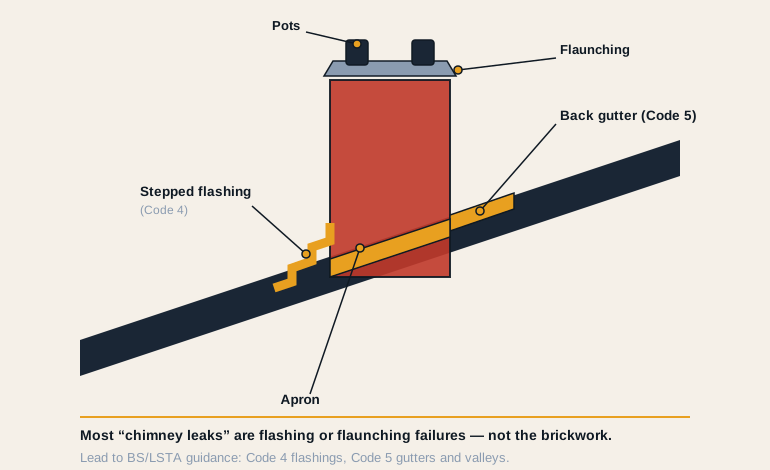
Lead is one of the oldest and most durable roofing materials on Chester properties. This guide covers the full range of lead applications on Chester period stock.
Leadwork roofing in Chester covers flashings, valley linings, flat bay roofs and parapet cappings on period properties. Code 4 lead is standard; Code 5 for exposed parapets. Lead is the only conservation-correct material for flashings on Chester period roofs. Free surveys and written quotes across all Chester postcodes with no obligation.
Lead roofing in Chester covers: chimney flashings; valley linings; flat bay window roofs; parapet cappings; dormer flashings; and internal parapet gutters on Victorian Chester properties. Each application has different lead code requirements and different failure modes. Understanding which application you have and what code is required is the foundation of specifying lead work correctly on Chester properties.
The Lead Sheet Training Academy specifies lead codes by application and exposure, with expansion joints at set intervals — correctly specified Code 4 lead lasts 60 to 100 years on Chester properties versus 20 to 40 for undersized work.
Source: Lead Sheet Training Academy (LSTA)
Victorian and Edwardian Chester terraces in Hoole and Boughton frequently have bay windows with lead-covered flat roofs. These may be 100 to 140 years old. A single-sheet Code 4 lead bay replacement with correct drips and drains is the appropriate specification. We do not patch-repair deteriorated lead bay roofs on Chester period properties where more than 30% of the surface shows pinhole oxidisation.
Parapet walls on Chester Victorian detached and semi-detached properties in Boughton and Newton are capped with lead to shed water from the masonry core. Parapet cappings require Code 5 lead due to exposure and thermal movement. Parapet capping failure manifests as damp penetration through the top of the party wall, frequently misdiagnosed as a rising damp or structural issue.
Lead is the only conservation-correct material for flashings, valley linings and flat bay roofs on Chester period properties. Rubber collar kits and aluminium flash tape are visible from the street and are not acceptable in Chester conservation areas. We carry Code 4 and Code 5 lead on all vehicles and complete standard lead applications on the same visit as the survey.
No call-out fee · 24/7 · 10yr guarantee
Lead is the traditional weatherproofing metal on Chester’s period roofs — here is how to tell whether your leadwork needs repair, re-dressing or full renewal.
When it is not the answer: If a flashing has simply come loose but the lead itself is sound, re-dressing and re-pointing it back in is enough — you do not need full renewal. Read the full guide.
We assess the lead code, the detailing and whether it can be re-dressed or needs renewing.
A fixed price specifying the correct lead code and the extent of the work.
Scaffold or tower up; failed lead carefully removed without damaging the surrounding roof.
New lead of the correct code cut, dressed and fixed to Lead Sheet Association detailing, with proper welts, clips and patination oil.
Pointing made good, debris cleared, and the workmanship guarantee handed over.
| Job | Typical duration |
|---|---|
| Flashing re-dress | Half a day–1 day |
| Lead valley renewal | 1–2 days |
| Chimney lead renewal | 1–2 days |
| Ornate/heritage leadwork | Job-specific |
Lead work needs dry conditions for pointing to cure; we schedule heritage detailing around the weather.
Leadwork needs scaffold or a tower for safe standing time and careful dressing of the metal. Scaffold is specified for: valley and chimney lead renewal, and most heritage leadwork - always itemised in your written quote, never a hidden extra, and we arrange it.
Chester’s Victorian and Edwardian terraces in Hoole, Boughton and Newton often have narrow frontages and limited rear access, so scaffold has to be planned carefully and sometimes needs permit-controlled pavement space; detached properties in Upton and Vicars Cross with open drives are simpler. Pavement scaffold and skip permits go through Cheshire West and Chester Council; allow a few working days on streets like the terraced streets off Hoole Road, Faulkner Street in Hoole, the lanes around Boughton where space is tight.
| Job | Typical range | Notes |
|---|---|---|
| Flashing re-dress & repoint | £200–£450 | Per abutment |
| Lead valley renewal | £600–£1,500 | Code 4–5 lead |
| Chimney lead renewal | £400–£900 | Per stack |
| Ornate/heritage leadwork | £800+ | Job-specific |
| Lead (supply) | £90–£140 | Per m², code dependent |
Worked example: Renewing a cracked lead valley in Code 5 lead on a Chester period property, dressed to Lead Sheet Association detail: around £700–£1,100.
No deposit on small flashing repairs. Staged payments on valley and heritage renewal — nothing before materials are on site. VAT invoiced.
Leadwork carries the 10-year workmanship guarantee; correctly-coded, correctly-dressed lead lasts decades longer than the mortar-fillet shortcuts it so often replaces.
If a fault appears in covered work, we come back and put it right. No quibbling, no re-charge.
Scaffold or tower for a day or two and careful, quiet work — leadwork is detailing, not demolition. We protect the property throughout. You do not need to stay home for external work - we just need power and access agreed in advance.
Lead dressing runs in most weather, but the associated pointing needs a dry spell to set properly. Chester’s wet, cool north-west climate — around 750mm of rain a year and exposed to gales off the Irish Sea — means we build weather margin into every booking and weatherproof open work the same day.
Code 4 for standard bay roof applications. Code 5 for exposed parapet cappings.
Correctly specified Code 4 lead lasts 60 to 100 years. Code 3 undersized lead may fail in 20 to 40 years.
A standard Victorian Chester bay flat roof replacement in Code 4 lead costs 400 to 800 depending on size and access.
No. Lead is the only conservation-correct material. Rubber collar kits have a 5 to 10 year lifespan versus 60 to 100 for Code 4 lead.
Lead coverings on the tops of parapet walls, requiring Code 5 lead. Failure causes damp through the top of the party wall.
Yes. Code 4 and Code 5 as standard. We advise on conservation area requirements at survey stage.
Yes. All lead roofing work is covered by NFRC registration and our 10-year guarantee.
Chester’s roofscape is unusually lead-dependent. The city’s wealth of Georgian, Victorian and conservation-area property — the terraces of Hoole and the Garden Quarter, the period stock around Handbridge and the listed buildings across the centre — relies on lead at every junction: chimney flashings, valley gutters, parapet and abutment details, and the dormer and bay detailing that defines the period look. Where a modern estate house might have a single simple flashing, a Chester Victorian villa can carry lead at a dozen points, each one a potential leak if it fails.
The commonest problem we are called to is not the lead itself failing — good lead lasts the best part of a century — but the mortar-fillet shortcut. Over the decades, previous repairs have too often smeared sand-and-cement fillets over junctions instead of dressing proper lead soakers and stepped flashings. Those fillets crack within a few winters as the roof moves and the temperature swings, and water tracks straight in behind them. Replacing a mortar fillet with correctly-dressed, correctly-coded lead is one of the most common and most worthwhile jobs on Chester’s period stock.
Lead is graded by code — essentially its thickness — and using the right one is the difference between a repair that lasts decades and one that fatigues and splits within years. Flashings typically call for Code 4; valleys and more exposed details need Code 5 or heavier. Using lead that is too thin to save money is a false economy that shows up as fatigue cracking along the fold lines within a few winters. We specify the correct code for each detail to Lead Sheet Association guidance, and we allow for thermal movement with proper welts, clips and joint spacing so the lead can expand and contract without tearing.
On listed and conservation-area property — of which Chester has a great deal — the correct lead detailing is often not just best practice but a planning requirement. We work to the traditional detailing the building and the council expect, finishing with patination oil to prevent the white carbonate staining that untreated new lead runs onto the surrounding stone and render.
No call-out fees. No obligation. Local Chester roofer.
0124 463 7110