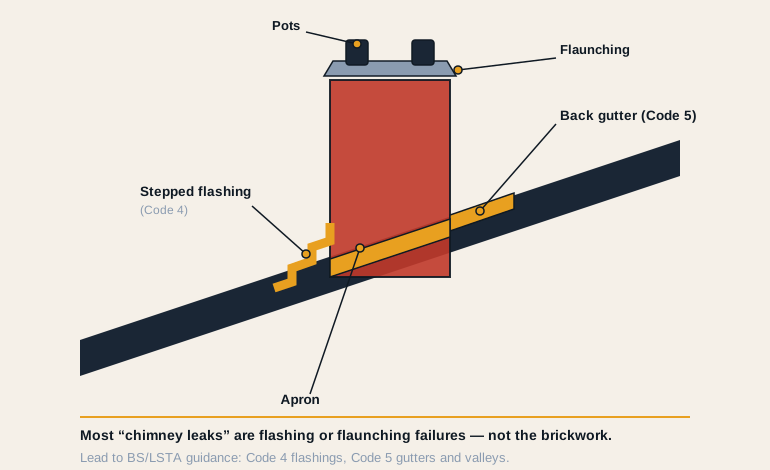
Lead roofing work in Newton covers the flashings, valley linings and parapet cappings on inter-war 1920s to 1950s properties where plain clay tile with hipped roofs is the dominant covering. Hip tile and ridge mortar displacement, plain clay tile breakage, lead valley failures — lead specification and condition are the most frequent contributing factors on CH2 call-outs.
We specify Code 4 (1.80mm) lead as standard for all chimney flashings, valley linings and flat bay roofs in Newton. Code 5 is specified for properties in more exposed or elevated positions where the elevated northeastern Chester approach with above-average wind loading on hip and ridge details creates additional demand on lead components. Code 3 undersized work — installed by previous contractors — is a frequent cause of the premature failures we are called to address in Newton.
Lead Specification for Newton Properties
The correct lead code for Newton depends on the application and exposure. Code 4 is correct for standard chimney flashings and valley linings on inter-war 1920s to 1950s Newton properties. The elevated northeastern Chester approach with above-average wind loading on hip and ridge details in Newton means that correctly specified Code 4 lead is essential — Code 3 undersized installations fail significantly earlier in Chester area conditions than in more sheltered southern locations.
Common Lead Failures in Newton
Hip tile and ridge mortar displacement, plain clay tile breakage, lead valley failures on inter-war 1920s to 1950s Newton properties. Stress cracking from thermal cycling where lead has been fixed in excessively long lengths without expansion allowance is the most common failure mode we address in Newton. Pinhole oxidisation after 50 to 70 years of service is the correct end-of-life indicator — at this point replacement rather than repair is the right specification.
Lead Repair vs Replacement in Newton
Localised lead repair — patching a pinhole or resealing a flashing upstand — is appropriate where the sheeting is structurally sound. Widespread pinhole oxidisation or stress cracking on inter-war 1920s to 1950s Newton properties indicates replacement is the correct call. Patching aged lead on a Newton property delays the inevitable and may void the warranty on any new tile or slate installation above it.
Pricing
Typical Costs in Newton
Indicative prices for Newton properties. Free written quotes for your specific job.
Lead is the traditional weatherproofing metal on Chester’s period roofs — here is how to tell whether your leadwork needs repair, re-dressing or full renewal.
Staining or damp below a chimney, valley or abutment
Lead flashing lifted, cracked or slipped out of the mortar
Splits or fatigue cracks along a lead valley or gutter
A previous repair using mortar fillets instead of proper lead
Ornate lead detailing on a period property needing attention
When it is not the answer: If a flashing has simply come loose but the lead itself is sound, re-dressing and re-pointing it back in is enough — you do not need full renewal. Read the full guide.
Proper stepped lead flashing and soakers — the detailing that mortar fillets can never match.The process
How a Newton Lead Roofing & Leadwork Job Runs
1. Survey the leadwork
We assess the lead code, the detailing and whether it can be re-dressed or needs renewing.
2. Written quote
A fixed price specifying the correct lead code and the extent of the work.
3. Access & strip
Scaffold or tower up; failed lead carefully removed without damaging the surrounding roof.
4. Dress new lead
New lead of the correct code cut, dressed and fixed to Lead Sheet Association detailing, with proper welts, clips and patination oil.
5. Finish & sign-off
Pointing made good, debris cleared, and the workmanship guarantee handed over.
Timescales
How Long Does It Take?
Job
Typical duration
Flashing re-dress
Half a day–1 day
Lead valley renewal
1–2 days
Chimney lead renewal
1–2 days
Ornate/heritage leadwork
Job-specific
Lead work needs dry conditions for pointing to cure; we schedule heritage detailing around the weather.
Access
Access, Scaffolding & Permits in Newton
Leadwork needs scaffold or a tower for safe standing time and careful dressing of the metal. Scaffold is specified for: valley and chimney lead renewal, and most heritage leadwork - always itemised in your written quote, never a hidden extra, and we arrange it.
Newton has a mix of 1930s semis and inter-war housing close to Hoole, with later development towards Great Boughton. Pavement scaffold and skip permits go through Cheshire West and Chester Council; allow a few working days on streets like Newton Lane, Plas Newton Lane, Mannings Lane where space is tight.
Pricing
Newton Lead Roofing & Leadwork: Cost Guide
Job
Typical range
Notes
Flashing re-dress & repoint
£200–£450
Per abutment
Lead valley renewal
£600–£1,500
Code 4–5 lead
Chimney lead renewal
£400–£900
Per stack
Ornate/heritage leadwork
£800+
Job-specific
Lead (supply)
£90–£140
Per m², code dependent
What moves the price
Lead code required (heavier = dearer)
Length and complexity of the detail
Whether it is repair, re-dress or full renewal
Heritage or listed detailing
Scaffold and access
Worked example: Renewing a cracked lead valley in Code 5 lead on a period property in Newton, dressed to Lead Sheet Association detail: around £700–£1,100 including access.
No deposit on small flashing repairs. Staged payments on valley and heritage renewal — nothing before materials are on site. VAT invoiced.
Guarantee
The Guarantee in Plain Terms
Leadwork carries the 10-year workmanship guarantee; correctly-coded, correctly-dressed lead lasts decades longer than the mortar-fillet shortcuts it so often replaces.
Covered: workmanship for 10 years, in writing, transferable if you sell.
On top: manufacturer warranties on materials (terms vary by product).
Not covered: storm or impact damage - that is an insurance matter, and we will document it for your claim.
If a fault appears in covered work, we come back and put it right. No quibbling, no re-charge.
Good to know
What It Is Like While We Work
Scaffold or tower for a day or two and careful, quiet work — leadwork is detailing, not demolition. We protect the property throughout. You do not need to stay home for external work - we just need power and access agreed in advance.
Lead dressing runs in most weather, but the associated pointing needs a dry spell to set properly. Newton sits on gently rising ground north-east of the centre, sharing Chester’s wet, gale-prone climate with heavy autumn leaf-fall from its mature street trees.
FAQ
Frequently Asked Questions
A standard chimney flashing replacement in Newton costs £250 to £520 for Code 4 installation. Valley lining replacement costs £350 to £700. Free written quotes across CH2.
Code 4 (1.80mm) is standard for chimney flashings and valley linings on inter-war 1920s to 1950s Newton properties. The elevated northeastern Chester approach with above-average wind loading on hip and ridge details in Newton means correct specification is essential — we do not install Code 3 on Newton properties.
Correctly specified Code 4 lead lasts 60 to 100 years. Code 3 undersized installations may fail in 20 to 40 years, particularly in Newton's elevated northeastern Chester approach with above-average wind loading on hip and ridge details.
Yes where the sheeting is sound and only the edge or joint has failed. Widespread pinhole oxidisation indicates replacement is the correct call. We establish this at the survey stage.
No — lead is the only conservation-correct material for period Newton properties. Rubber collar kits have a 5 to 10 year lifespan versus 60 to 100 for correctly installed Code 4 lead.
Yes — active leaks from failed lead flashings are treated as emergencies. Call 0124 463 7110 at any time.
Yes. All lead roofing work in Newton is covered by NFRC registration and our 10-year workmanship guarantee.
Get In Touch
Get Your Free Roofing Quote
No call-out fees. No obligation. Just an honest quote from a local Chester roofer.