Conservation-grade roofing for Chester's listed buildings and conservation areas — natural Welsh slate, clay peg tile, lime mortar and hand-dressed traditional leadwork, with conservation officer liaison and full consent advice.
Tell us the job in 30 seconds. No pushy sales, no call-out fee.
📞 Call Now: 0124 463 7110Heritage roofing in Chester uses natural Welsh slate, clay peg tile, lime mortar and traditional cast leadwork to conservation standard, with listed building consent liaison where required. It typically costs 20 to 40 percent more than a standard re-roof, reflecting natural materials and skilled hand-work. Free heritage surveys.
Chester is one of England's most historic cities, and its roofs reflect that — a dense concentration of listed buildings, extensive conservation areas, and a housing stock built in natural slate and clay over lime mortar. Roofing these properties correctly is a specialist discipline that demands the right materials, traditional skills, and an understanding of the conservation rules that govern what can be done.
The starting point on any heritage job is the property's status. Chester has numerous conservation areas — the historic core within and around the city walls, Handbridge across the Dee, and the Victorian suburbs — plus a large number of individually listed buildings. Listed status usually means roof work affecting the building's character needs listed building consent from Cheshire West and Chester Council, and conservation areas carry their own restrictions on visible materials and details.
Getting this right is not optional. Using the wrong material — a concrete tile where clay is required, cement where lime belongs, or a modern rooflight on a protected street elevation — can breach consent and require costly reinstatement. We survey the property, confirm its status, advise on what consent is needed, and can liaise with the conservation officer so the work proceeds correctly.
The materials themselves are the visible heart of heritage roofing. Chester's historic roofs are overwhelmingly natural Welsh blue slate and clay peg or plain tile, and matching them — often with reclaimed material — is essential for a result that is both compliant and right for the building. Bedding and pointing in lime mortar rather than hard cement allows the roof and the masonry beneath to breathe, as they were designed to.
Chester's heritage roofing work concentrates in its conservation areas, and knowing them is central to doing the job properly. The historic city centre — the Rows, Bridge Street, Watergate and Eastgate, and the buildings hard against the Roman and medieval walls — is the most sensitive, with listed buildings at every turn and roofs that must be treated with genuine conservation care.
Historic England and SPAB guidance stress that pre-1919 roofs should be repaired 'like for like' in matching natural materials and lime mortar, retaining as much original fabric as possible — the conservation principle we apply across Chester's listed and conservation-area roofs.
Source: Historic England / SPAB
Handbridge, across the Old Dee Bridge, is a conservation area of older cottages and Victorian housing where slate and clay dominate and the roofscape is protected. Just outside the walls, the Victorian suburbs of Hoole, Boughton, Newton and the Garden Quarter carry street after street of Welsh-slate terraces, many within conservation areas, where matching slate and preserving the uniform roofline is what keeps the character intact.
These areas share a common demand: like-for-like. A patched repair in mismatched slate, or a re-roof in the wrong tile, stands out immediately on a uniform period terrace and often breaches conservation requirements. We source reclaimed and new-to-match Welsh slate and clay tile precisely so repairs and re-roofs blend seamlessly into Chester's historic streets.
The dominant historic materials — Welsh slate, clay peg tile, lime mortar and cast lead — reflect what was available and durable when Chester's period housing was built. Respecting that palette isn't nostalgia; it's what keeps these roofs performing and these streets looking as they should. It's also, in listed and conservation contexts, what the law requires.
| Work | Typical Chester price |
|---|---|
| Welsh slate re-roof (heritage) | £180–£280/m² |
| Clay peg tile (heritage) | £160–£250/m² |
| Lead valley / flashing renewal | £300–£900 |
| Bay-top leadwork | by specification |
| Lime repointing / bedding | by specification |
| Conservation premium | +20–40% |
Indicative Chester prices for guidance. Every property differs — we provide a free written quote with no obligation. Prices held at 2026 rates.
Leadwork is at the heart of heritage roofing, and it's where much of the skill — and much of the watertightness — of a Chester period roof lives. Cast and milled lead has weathered the junctions of Chester's historic buildings for centuries, and doing it correctly is what separates genuine heritage roofing from a modern bodge.
Where a roof slope meets a wall, chimney or abutment, lead flashings and soakers weather the junction. On Chester's Victorian and Edwardian terraces these details are constant — around chimney stacks, against party walls, and at every change of plane. We dress lead in the correct code so it sits properly and lasts, rather than relying on sealant that fails within a few winters.
Lead-lined valleys carry water off Chester's steep period roofs at the internal angles, and they take a heavy load — especially under the tree canopy of Hoole and Boughton where leaves collect. A properly formed Code 5 lead valley, correctly lapped and clipped, handles decades of Chester rainfall; a poorly formed one is a leak waiting to happen.
Chester's Victorian and Edwardian houses are full of bay windows and porches with small lead-covered roofs. These bay tops are a classic heritage leadwork job — correctly welted, bossed and laid to falls so water sheds cleanly. We renew failed bay-top leadwork to traditional standards, keeping the period appearance intact.
Lead is specified by code — its thickness. Using too thin a lead, or dressing it badly, causes splitting and failure. We use Code 4 for soakers and small flashings, Code 5 for valleys and cover flashings, and heavier codes for exposed runs, dressing each by hand to the traditional standard that Chester's heritage roofs were built to.
Heritage roofing rewards experience and punishes shortcuts, and on Chester's protected buildings the stakes are high — both for the fabric and for compliance.
A general roofer unfamiliar with listed building consent can inadvertently breach it, leaving the owner facing enforcement and reinstatement. We understand Chester's conservation framework and work within it, liaising with the conservation officer so the roof is right and the paperwork is sound.
Hand-dressing lead, laying natural slate to a true line, bedding ridges in lime, matching reclaimed materials — these are traditional skills that modern volume roofing has largely lost. They're exactly what Chester's heritage roofs were built with, and exactly what keeps them standing for another century.
No call-out fee · 24/7 emergency · 10-year guarantee
"Re-roofed our listed Handbridge cottage in reclaimed Welsh slate with proper lime bedding. Liaised with the conservation officer throughout. Impeccable."
"Renewed the lead valleys and bay top on our Victorian Hoole terrace. The leadwork is a genuine craft — you can see the difference. No more leaks."
"Sensitive slate repairs on our conservation-area house in Boughton, matched so well you can't see the join. Exactly the specialist we needed."
Yes. We specialise in heritage roofing across Chester's conservation areas and listed buildings — natural Welsh slate, clay peg tile, traditional leadwork and lime mortar, using conservation-appropriate materials and methods, and liaising with the Cheshire West and Chester conservation team where consent is required.
If your property is listed, most roof work affecting its character needs listed building consent from Cheshire West and Chester Council, even like-for-like repair in some cases. Conservation-area properties have restrictions too. We advise on what's needed and can liaise with the conservation officer.
Natural Welsh blue slate and clay peg or plain tile dominate Chester's historic roofs, bedded and pointed in lime mortar, with cast lead used for flashings, valleys and bay tops. Matching the original material and detailing is central to conservation-compliant work.
Heritage roofing uses natural materials that cost more than modern substitutes, demands skilled hand-work and traditional detailing, and often requires like-for-like sourcing of reclaimed slate or tile. Add the conservation consent process, and the premium over a standard re-roof is typically 20 to 40 percent — but the result is correct and durable.
Leadwork is the use of cast or milled lead for flashings, soakers, valleys, bay tops and chimney weathering. On Chester's period properties, correctly dressed lead in the right code is what keeps the roof watertight at every junction — and it's a traditional skill that distinguishes heritage roofing from general work.
We use the correct lead code for each application — typically Code 4 for soakers and smaller flashings, Code 5 for valleys, aprons and cover flashings, and Code 6 or higher for exposed or long-run details. Using the right code and dressing it properly is essential for longevity.
Yes. We source reclaimed and new-to-match Welsh slate and clay tile to blend with the existing roof, essential for conservation-area and listed work where a mismatched patch is both visually wrong and often non-compliant.
Yes. Where listed building consent or conservation-area approval is needed, we can liaise with the Cheshire West and Chester conservation team, advise on requirements, and carry out the work to the standard the consent requires.
Last reviewed: 07 August 2026
Chester’s listed and conservation-area properties need heritage-appropriate roofing — here is how to tell your roof needs a specialist rather than a standard re-roof.
When it is not the answer: If your property is a standard post-war house outside a conservation area, you do not need — or want to pay for — heritage-grade materials; a like-for-like modern re-roof is right. Read the full guide.
We assess the original materials, the conservation or listed status, and what the council will require.
We flag where listed building consent or conservation-area rules apply and what that means for materials.
A fixed price specifying reclaimed or matching materials, lead codes and traditional detailing.
Natural slate or clay laid correctly, lead dressed to code, lime mortar used where the building needs to breathe.
Site cleared, the roof left true to its period, and the workmanship guarantee handed over.
| Job | Typical duration |
|---|---|
| Heritage slate repair | 1–3 days |
| Lead valley or flashing renewal | 2–4 days |
| Full heritage slate re-roof | 2–4 weeks |
| Ornate ridge/detail work | Job-specific |
Heritage hand-work and material sourcing take longer than modern roofing — the quote gives a realistic window.
Heritage work always needs proper scaffold for safe, careful handling of fragile slate and detailed leadwork. Scaffold is specified for: all heritage re-roofing and most heritage repairs — careful access protects fragile materials - always itemised in your written quote, never a hidden extra, and we arrange it.
Chester’s Victorian and Edwardian terraces in Hoole, Boughton and Newton often have narrow frontages and limited rear access, so scaffold has to be planned carefully and sometimes needs permit-controlled pavement space; detached properties in Upton and Vicars Cross with open drives are simpler. Pavement scaffold and skip permits go through Cheshire West and Chester Council; allow a few working days on streets like the terraced streets off Hoole Road, Faulkner Street in Hoole, the lanes around Boughton where space is tight.
| Job | Typical range | Notes |
|---|---|---|
| Heritage slate repair | £300–£1,200 | Matched materials |
| Lead valley renewal | £600–£1,500 | Code-correct lead |
| Natural Welsh slate re-roof | £180–£280 | Per m² |
| Strip-and-relay (reclaim slate) | £120–£180 | Per m² |
| Handmade clay tile | £140–£220 | Per m² |
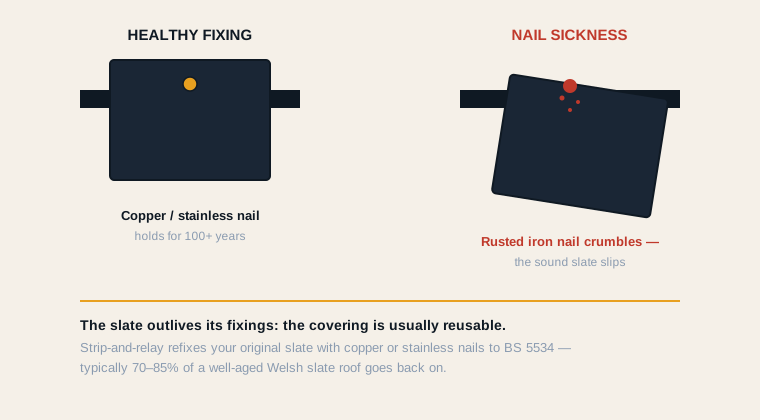
Worked example: A strip-and-relay on a Garden Quarter Victorian terrace, reusing 80% of the original Welsh slate with new underlay and fixings: around £160/m².
Staged payments on heritage re-roofs; nothing up front before materials are on site. VAT invoiced.
Heritage workmanship carries the 10-year guarantee; natural slate can last a century, and correct lead detailing to code is what protects the whole roof.
If a fault appears in covered work, we come back and put it right. No quibbling, no re-charge.
Scaffold for the duration and careful, methodical work — heritage roofing is not rushed. We protect the property and grounds throughout. You do not need to stay home for external work - we just need power and access agreed in advance.
Slate and lead work needs dry spells; we phase heritage jobs and weatherproof carefully given Chester’s exposed, wet climate. Chester’s wet, cool north-west climate — around 750mm of rain a year and exposed to gales off the Irish Sea — means we build weather margin into every booking and weatherproof open work the same day.
No call-out fees. No obligation. Local Chester roofers who answer the phone.
0124 463 7110